
When the Safety Net Shrinks, Who's Left Holding It?
March 26, 2026
Most federal policy changes arrive slowly enough that foundations can watch, assess, and respond over time. The SNAP cuts embedded in H.R. 1, the One Big Beautiful Bill Act (OBBBA), are different. The eligibility changes are effective immediately. The cost shifts to states begin in 2027. The pressure on local food relief networks is already building.
The Food Research and Action Center (FRAC) published a City Playbook in February 2026 aimed at municipal leaders preparing for these impacts. It is worth reading even if you work in philanthropy rather than city government, because the document makes something uncomfortably clear: when federal food assistance contracts, the demand doesn't disappear. It redistributes. And a significant portion of it lands on the organizations community foundations fund.
What OBBBA actually does
The legislation makes several changes that compound each other at the local level.
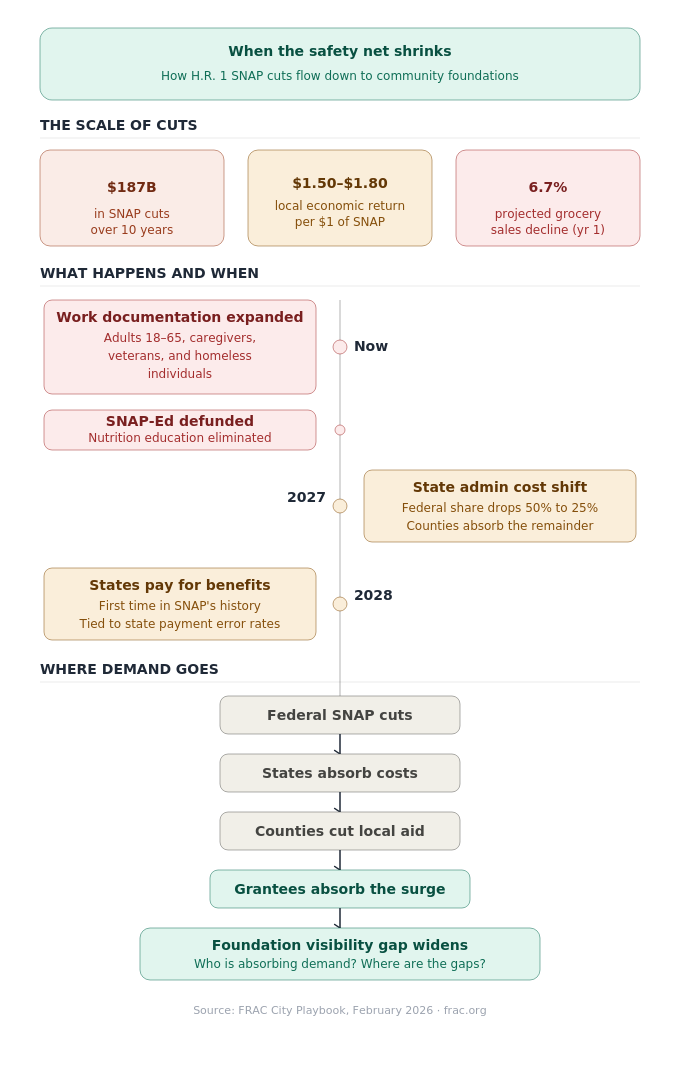
Expanded work documentation requirements now reach far beyond their original scope, covering adults through age 65, caregivers of teenagers, veterans, and people without stable housing. Research consistently shows these requirements don't increase employment. They increase paperwork failures, causing eligible people to lose benefits not because they stopped working, but because documentation is difficult to produce consistently when life is unstable.
Beginning in fiscal year 2027, states absorb a dramatically larger share of SNAP administrative costs. In North Carolina and several other states, counties bear the entire non-federal share. That means counties will face higher costs at the exact moment when demand on local human services is rising. The downstream effect for cities and foundations is reduced public funding available to fill gaps.
Beginning in fiscal year 2028, states will also be required to pay a portion of food benefits themselves, not just administrative costs, a first in SNAP's history. Most states hover near or above the 6 percent payment error threshold that triggers mandatory contributions, which will create volatile budget impacts and force cuts elsewhere.
And perhaps least discussed: SNAP-Ed has been defunded as of fiscal year 2026, eliminating federal dollars that previously supported nutrition education, healthy food access initiatives, and community partnerships like gardens and cooking classes. For many foundations, these programs were part of the infrastructure their grantees depended on.
The redistribution problem
Every federal dollar invested in SNAP generates between $1.50 and $1.80 in local economic activity. When those dollars shrink, the contraction is not abstract. It shows up in grocery store closures, reduced sales tax revenue, and households forced to choose between food and rent. The National Grocers Association projects a 6.7 percent sales reduction for independent grocers in the first six months alone, and store closures in vulnerable neighborhoods could create or worsen food deserts.
For foundations, this creates a compounding challenge. Your grantees will absorb more demand. The public systems that complemented their work will have less capacity. And the populations they serve will arrive in more acute distress because they lost benefits before finding their way to a food pantry. Faith organizations, food pantries, and nonprofits will absorb rising demand but cannot meet the scale of federal disinvestment.
Philanthropy is not a substitute for federal food assistance at scale. But that's the position the sector is being placed in, and the foundations best positioned to respond will be the ones that understood this was coming and acted before the surge.
What readiness actually looks like
FRAC's playbook frames municipal readiness around 13 action steps. Several translate directly to foundation strategy. The first is understanding the full local impact before it arrives. How many of your grantees' clients are SNAP-dependent? What share of your food pantry grantees' clients will lose benefits under expanded time limits? Which ZIP codes in your service area are most exposed? Most foundations cannot answer these questions from their current reporting infrastructure. That gap is worth naming directly.
The second is coordination with philanthropy, which FRAC frames as a municipal responsibility but which foundations can lead proactively. The playbook pushes municipal leaders to bring foundations to the table, map where public funding will fall short, and build coordinated responses across city agencies, nonprofits, and philanthropy rather than leaving each sector to improvise separately. This is a different posture than waiting for local government l to convene you.
The third is data infrastructure. FRAC recommends tracking benefit losses, food insecurity, and retail closures in real time, and adjusting response based on emerging trends rather than lagging indicators. Traditional quarterly grantee reports will not surface this information fast enough to be useful.
The visibility question
This is where I want to be direct about something we hear consistently in conversations with foundations: the coordination challenge OBBBA creates is not new. It is an acceleration of something that was already true. Foundations have been managing food relief grantee networks with limited visibility for years. Quarterly reports, fragmented spreadsheets, anecdotal updates from site visits. That approach was imperfect when demand was stable. When demand spikes unevenly across a region, the cost of that information gap becomes much higher.
Knowing which organizations are absorbing the surge, which neighborhoods have lost coverage because a key partner is overwhelmed, and where duplication is wasting scarce capacity, these are not nice-to-haves in a period of contraction. They are what separates a strategic response from a reactive one. It's part of why we built FastRoots: to give foundations real-time visibility into what's actually happening across their grantee networks, not just what showed up in last quarter's report.
The window before the surge
FRAC's core argument is simple: communities that build their response infrastructure now will be far better positioned than those that wait until demand has already overwhelmed their grantee networks. The same logic applies to foundations. The eligibility changes are already in effect. The cost shifts arrive next year. The demand surge is not speculative. It is a predictable consequence of a policy already signed into law. The question for foundation leaders isn't whether this is coming. It's whether your organization will have the infrastructure to respond to it strategically when it does.
The FRAC City Playbook is available at frac.org. It's 15 pages and worth the full read.