
The Handoff: Why Charitable Food Recovery Is Getting Harder Just When We Need It Most
April 30, 2026
The Handoff
I spent Tuesday at the Western North Carolina Food Waste Solutions Summit hosted by Food Waste Solutions WNC. The day was billed as a conversation about food rescue, consumer education, and composting, but what stayed with me had less to do with waste and more to do with what is quietly breaking inside the charitable food system.
The clearest example came up in the rescue and redistribution session: the weekly handoff between a grocery retailer and a local food pantry. On paper, it is a simple transaction. A truck pulls up, food gets transferred, and a community gets fed. In practice, it is one of the most fragile coordination points in the entire emergency food network, and it is getting more fragile every year.
What the handoff actually requires
Most retailer donation programs are nominally managed by a regional food bank, but the week-to-week reality lives between a store manager and a pantry coordinator. For that relationship to hold, several things have to be true at once.
The retailer needs a partner who shows up on the scheduled day, every week, without fail. They need that partner to take the entire donation, not the parts that are convenient. Big-box stores do not have the bandwidth to split a single day's donation across three different pantries based on who has refrigeration, who has volunteers, and who has a truck.
The pantry, on the other side, needs the things most pantries do not have in abundance: reliable transportation, cold storage, and people available on the day the retailer needs the donation moved. Many pantries operate one or two days a week with volunteer crews. The retailer's donation calendar does not bend to match. If the food is ready Wednesday and the pantry opens Saturday, the math fails.
Then there is reporting. Both sides need documentation, for tax purposes on the retailer side and for compliance on the pantry side, and the two sets of paperwork rarely talk to each other.
None of this is anyone's fault. It is what happens when a critical piece of community infrastructure is held together by goodwill, personal relationships, and a patchwork of independent organizations operating on thin margins.
The squeeze nobody planned for
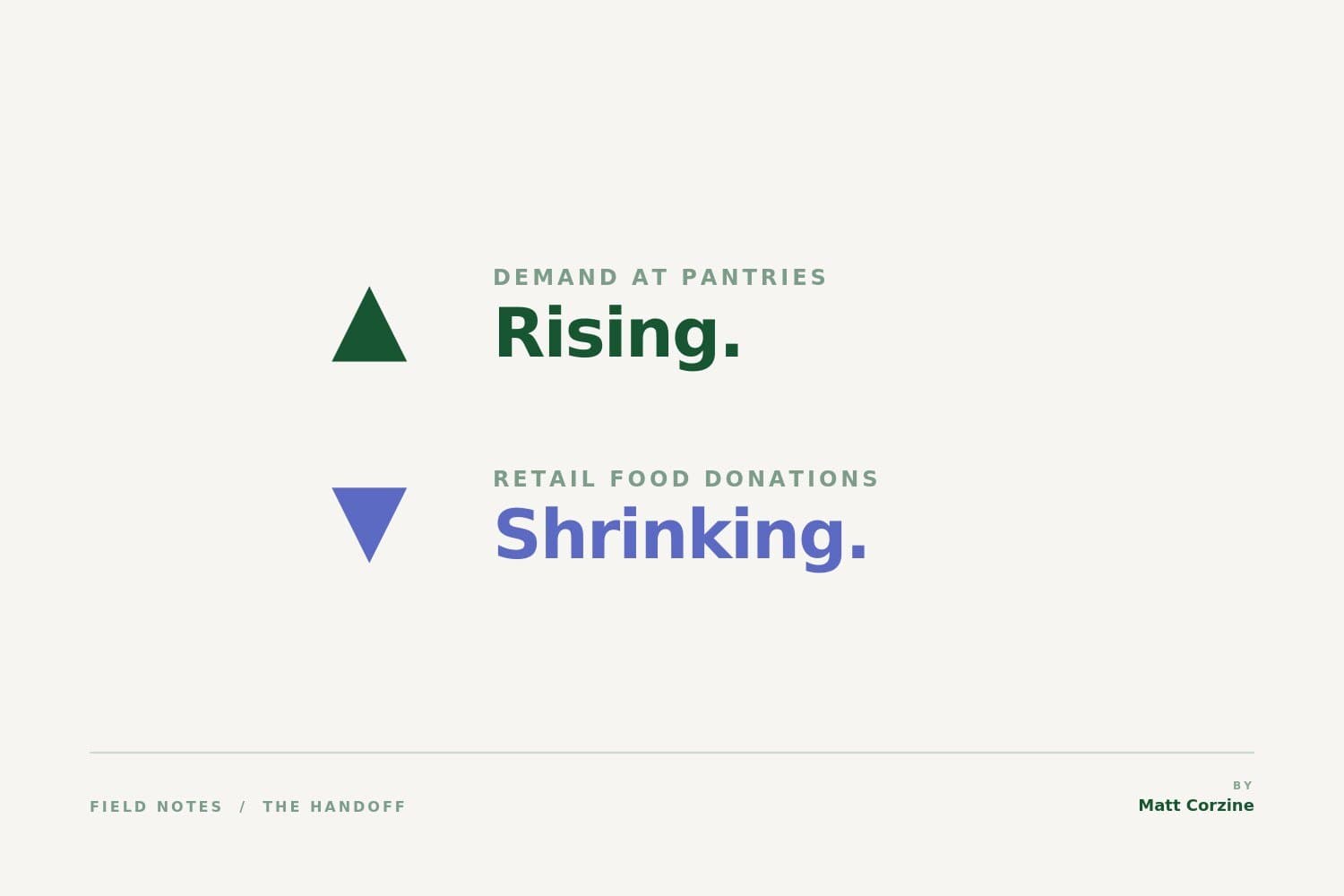
Here is the part that should concern every funder working in this space: the supply side of charitable food is shrinking at the same time demand is climbing.
Retailers have gotten dramatically better at forecasting. Improved inventory technology, tighter supply chains, and online ordering have reduced the surplus that used to flow naturally to food banks. This is, in most respects, a good outcome. Less waste at the source is what we have been asking grocery chains to deliver for decades. But it has a downstream consequence we did not adequately plan for. Retail donations historically supplied roughly 30 percent of what U.S. food banks distribute. As that channel narrows, the gap has to be filled somewhere.
At the same time, demand is moving in the opposite direction. SNAP enrollment has dropped by roughly 4 million people between January 2025 and January 2026, following the work requirement expansions and eligibility changes in the One Big Beautiful Bill Act. The Center on Budget and Policy Priorities and the Food Research and Action Center have both documented that the people losing benefits are not, in the main, finding employment that replaces what they lost. They are showing up at pantries.
Add to that the steady pressure of grocery prices, which are about 29 percent higher than they were in 2020, and rising costs for fuel and utilities, and you have a population with less buying power, less federal assistance, and more need.
So the structure looks like this: charitable food providers are being asked to absorb growing demand from SNAP-displaced households while their largest single source of donated product is contracting and the operational handoffs that govern what they do receive are increasingly difficult to staff and execute.
What this means for funders
If you fund food relief in a community, the temptation is to respond to a squeeze like this with more grants for food purchase. That helps. It is also insufficient.
The harder problem is that the system is losing slack faster than any single grant can replace it. The slack used to live in retailer surplus. It used to live in the assumption that SNAP would carry the floor. Both of those assumptions are weaker than they were a year ago, which means the operational layer, the actual logistics of how food moves from a loading dock to a family, is doing more work with less margin for error.
A few questions worth asking the organizations you fund:
Who manages the relationship with each retailer in your service area, and what happens when that person leaves? How much of your weekly inbound food depends on a single volunteer with a pickup truck? Where in your county does refrigerated storage sit, and how does food get from the donation point to that storage and back out to distribution? When two pantries serve overlapping neighborhoods, do they know what the other is receiving, and from whom?
These are not glamorous questions. They do not produce the kind of impact metrics that show well in a board deck. But they are the questions that determine whether the system can actually deliver on the dollars you are putting in.
The quiet conclusion
The Summit was a useful reminder that the people doing this work understand the problem better than almost anyone. They know exactly where the handoffs break. What they do not always have is a funder ecosystem that recognizes coordination as a fundable activity in its own right, separate from food, separate from facilities, separate from staff salaries.
The squeeze is not going to ease in 2026. The retailer side will keep getting more efficient. SNAP will continue contracting. Demand will continue climbing. The question for foundations is whether we will keep funding emergency food the way we always have, or whether we will start putting real resources behind the connective tissue that makes the rest of it work.