
For Henderson County neighbors
The Henderson County Food Finder is live with the Community Foundation of Henderson County: a free map of every verified food resource in the county.
A simple way to find food assistance near you — locations, hours, and what each provider offers.
Una forma sencilla de encontrar asistencia alimentaria cerca de usted.
Find food near youFor conveners & funders
See where the need is. Coordinate the response.
FastRoots builds and maintains your region’s verified food security data, with a living public map your whole community can use.
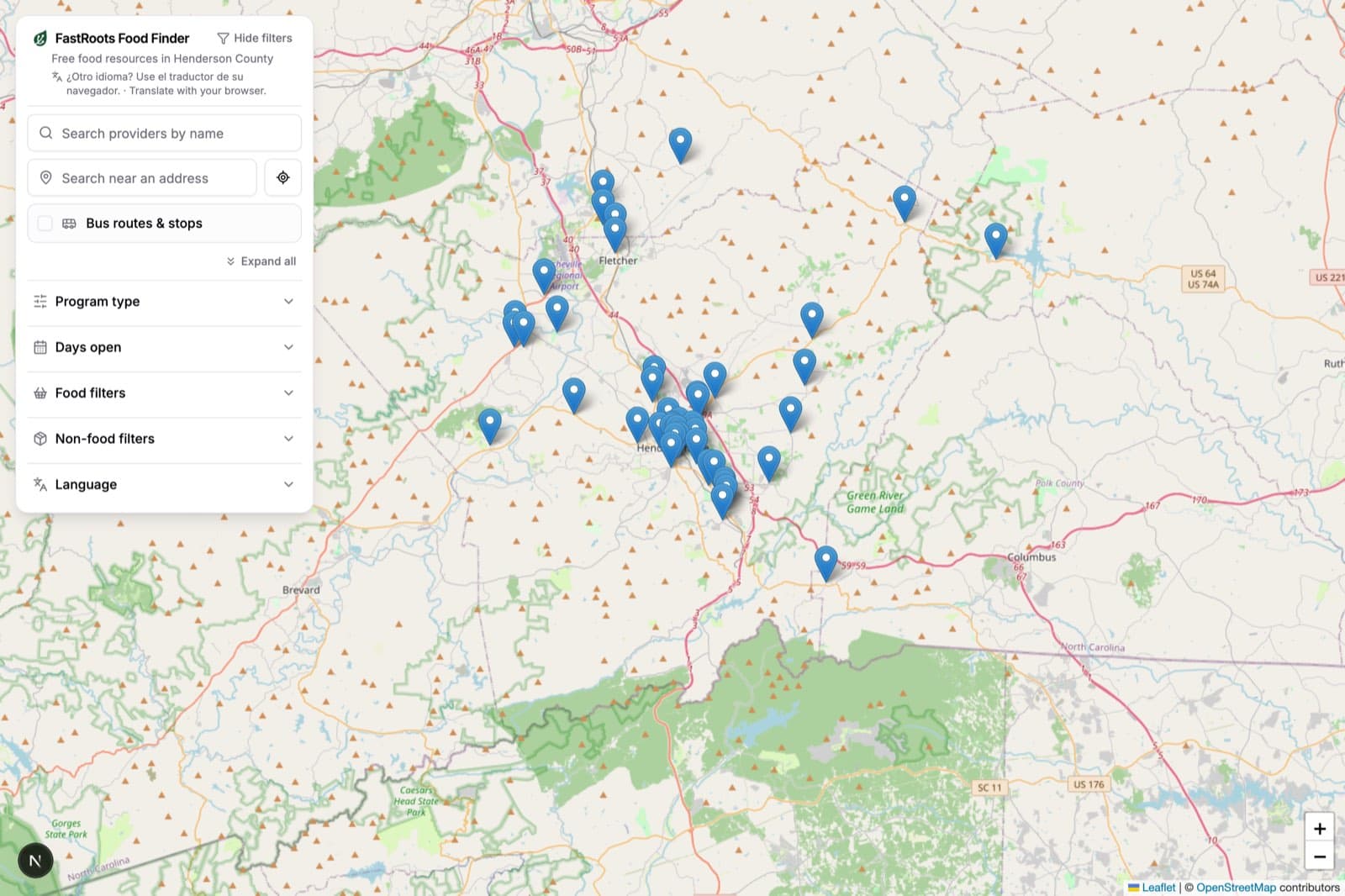
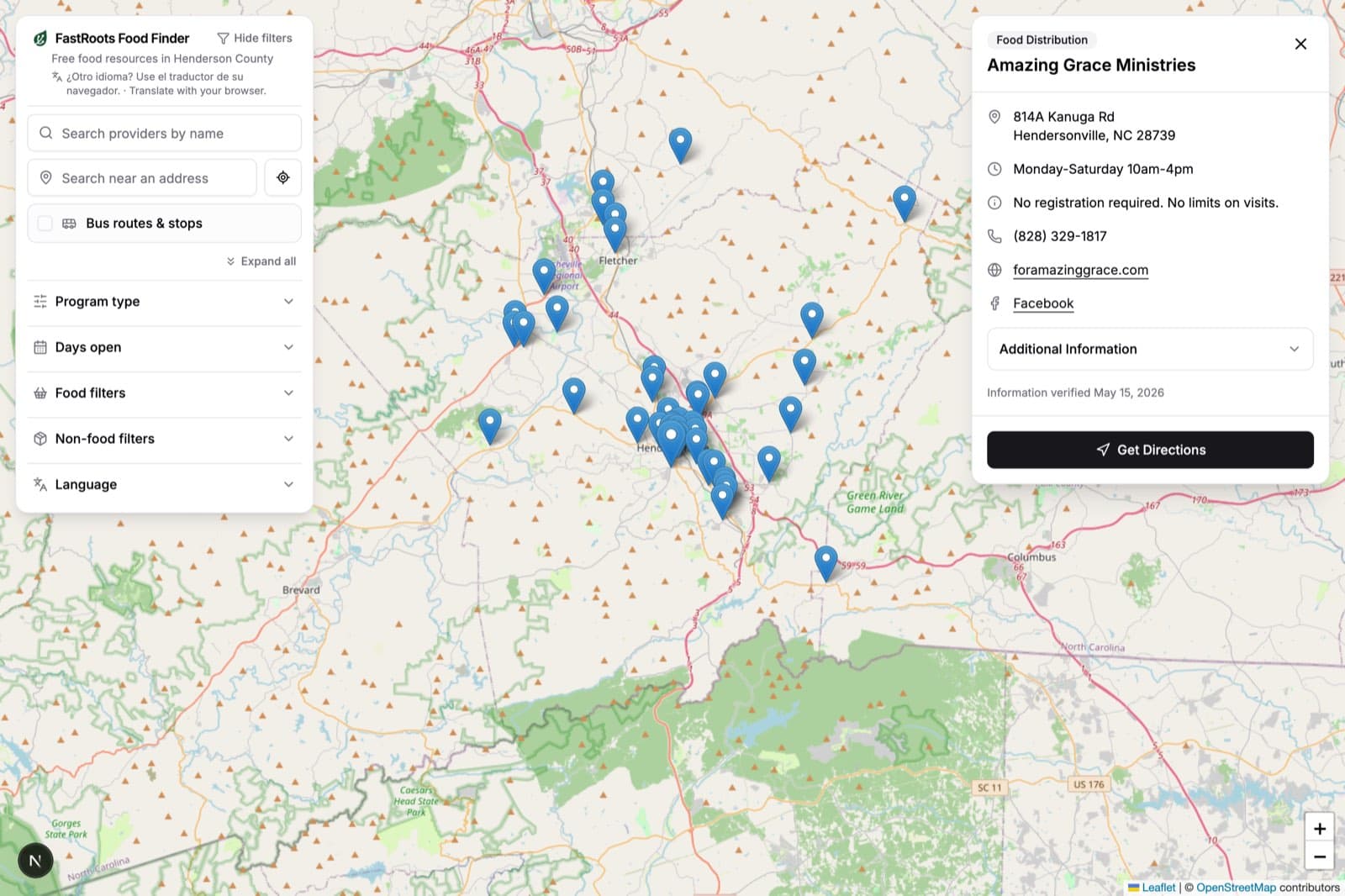
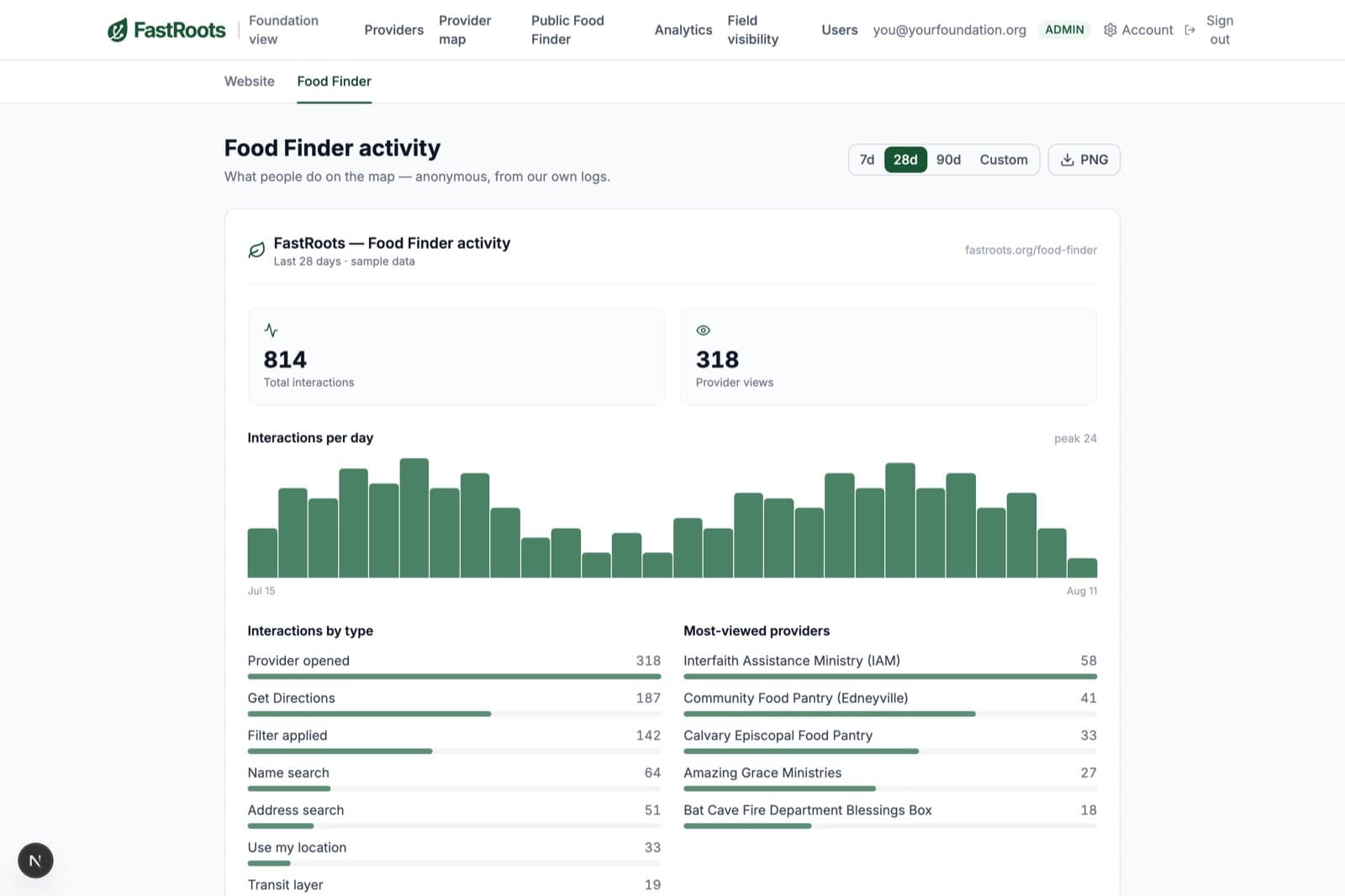
The public map your community uses
National platforms tell you a pantry exists. FastRoots tells you whether it was open last Tuesday, who it served, and what need it couldn’t meet. We pay someone in your community to know.
Verified, not just mapped.
Every resource list your region has (the 211 listings, the PDF guides, the one-off maps) went stale the day it was made. FastRoots exists to end that.
Step 1
We build your county’s verified data
Trained, paid community stewards find and confirm every charitable food provider through first-hand conversations. Not web scrapes, not self-reported forms.
Step 2
We keep it alive
Every provider re-verified each quarter by the same local steward. Freshness is the product; everything else goes stale.
Step 3
You put it to work
Need maps, usage analytics, and gap evidence (“searched and found nothing”) that strengthen grant applications, donor conversations, and board decisions.
Step 4
Your community gets the map
A branded public Food Finder your neighbors actually use: the visible public good, with your name on it.
Built for whoever convenes your region
Community foundations
See where need concentrates: one shared, verified picture for your board, your grant partners, and your donors.
Food councils & coalitions
Verified data your whole coalition works from. Coordination instead of silos.
Health departments & United Ways
Verified referral data for CHNA work and 211-adjacent programs.
Hub nonprofits
Your PDF resource guide, alive — and citable in every grant application.
Data that pays for itself.
Grant partners cite the need maps and gap data in their applications. Development teams put the live map in front of donors and fund holders — verified need a donor can see converts statistics into giving. One incremental grant or gift covers the subscription.
Proven in the field
Henderson County, North Carolina
Henderson County: a living map, funded by the community
In partnership with the Community Foundation of Henderson County, we built one shared source of truth for food assistance in the county. It now powers a board-facing map for grant decisions, and the public Food Finder open to every Henderson County neighbor.
“FastRoots compiled detailed profiles on all food assistance providers across Henderson County through direct outreach, including church pantries and programs that operate independently. It’s the most complete picture of our food relief ecosystem we’ve ever had, and our board and committees now use the interactive map to better understand the needs landscape of our area.”
Hurricane Helene relief coordination
Three organizations, 12-county Western NC region
45
Relief centers mapped
12
Counties covered
106K+
Meals & food boxes
1st
Regional impact report
“Instead of working in silos, the grantee organizations used shared data to coordinate distribution. It’s a model we hope to see in future recovery grants.”
Built to last on community-scale funding — not on a waiver, a grant cycle, or a state budget line.
Common questions
We already have a resource guide / Google Map / ArcGIS map.+
Good. We import it. That’s the start, not the competition. What your map can’t tell you is whether it’s still accurate next quarter, who’s using it, and where people searched and found nothing.
How is this different from Findhelp, 211, or Feeding America’s finder?+
National directories list around a million programs and review listings on multi-month, self-reported cycles. FastRoots pays a trained steward in your community to verify every provider, every quarter, in person or by phone, and captures what no directory has: capacity, conditions, and unmet need.
How is this different from a needs assessment or mapping study?+
A study is a photograph; this is a live feed. Assessments tell you what was true the year they were written and start going stale on delivery. FastRoots is working infrastructure: verified again every quarter, used daily by neighbors, staff, and donors, and more valuable every year as usage and gap data accumulate. Already have an assessment? Send it over. We’ll load it as the starting point and show you what’s changed since.
Who keeps the data current?+
That’s the subscription. Quarterly human verification by your county’s steward, provider self-service in between, and continuous monitoring. Freshness is the product.
How does this help us raise money?+
Need maps and gap data strengthen grant applications and donor asks — for you and for every partner working from the same data.
What does it cost?+
Each county is funded by an anchor sponsor (typically a community foundation, coalition, health department, or county government), with secondary subscriptions for partner organizations. Providers never pay to be listed or verified. Tell us your region and we’ll talk specifics.
Is this only for food?+
Food need is the canary in the coal mine: the lowest-barrier signal of household distress. The same verified data infrastructure extends to housing, benefits enrollment, utility assistance, and family services.
Tell us your region.
If we’re building near you, we’ll show you the region live. If we’re not, founding sponsors choose where we go next.