
Same Cart, Different Price: What Instacart's Pricing Experiments Mean for Food Security
January 5, 2026
Really, Instacart?
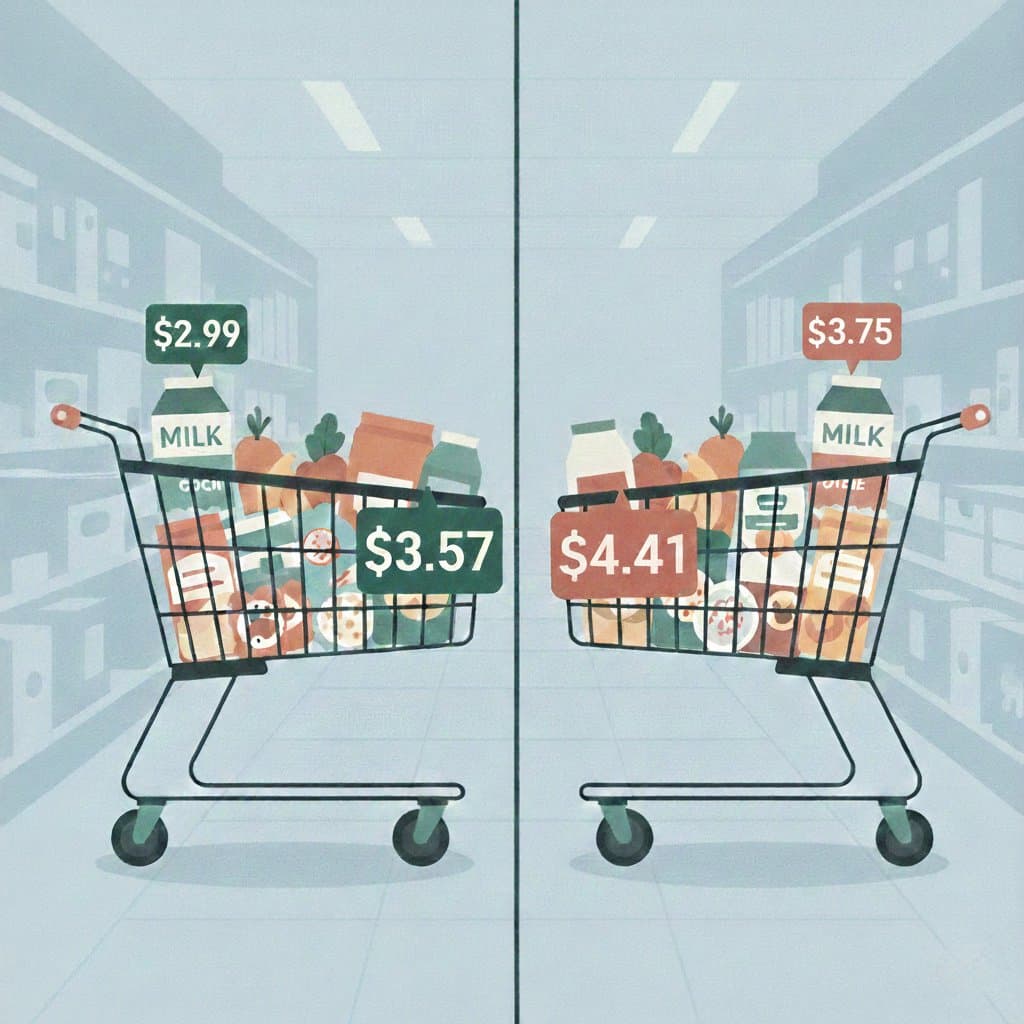
That was my first reaction when I read the Groundwork Collaborative and Consumer Reports investigation published in December 2025. Same store. Same items. Same time. Different prices, with some shoppers paying up to 23% more than others for the exact same groceries.
My second reaction was slower and heavier: what does this mean for the families who can least afford it?
What the Research Found
The investigation was straightforward in design and damning in results. Researchers from Groundwork Collaborative, Consumer Reports, and More Perfect Union recruited 437 shoppers across four cities and had them simultaneously add identical items to their Instacart carts from the same stores. Then they compared prices.
Nearly three-quarters of the grocery items tested were offered at multiple price points. A dozen eggs at a Safeway in Washington, D.C., appeared at five different prices ranging from $3.99 to $4.79. A box of Wheat Thins in Seattle showed four price tiers, with 62% of shoppers seeing the highest price. Across all tests, basket totals varied by an average of about 7%.
Seven percent might not sound like much. But Instacart's own estimates put annual grocery spending for a family of four at roughly $17,400 through the platform. A 7% swing translates to approximately $1,200 per year.
The mechanism behind this: Instacart's 2022 acquisition of Eversight, an AI-powered pricing platform that runs continuous experiments on shoppers. Instacart's own marketing materials describe the approach with remarkable candor, noting that individual shoppers won't notice small price changes on a few products, but at scale, those changes generate valuable data. The company's CEO explained on a 2024 earnings call that new AI algorithms help determine which product categories customers are more price-sensitive about and adjust prices accordingly.
The Fallout Was Swift
The investigation triggered a cascade of consequences. The FTC sent a civil investigative demand to Instacart. New York Attorney General Letitia James sent a formal letter demanding information about the company's compliance with the state's Algorithmic Pricing Disclosure Act. Separately, the FTC reached a $60 million settlement with Instacart over deceptive subscription and advertising practices.
On December 22, 2025, Instacart announced it was ending all item price tests on its platform, effective immediately. Retailers would no longer be able to use Eversight technology for pricing experiments on Instacart.
But the announcement came with caveats. Instacart noted that retail partners would "continue to set their own prices" and that the company would "continue offering relevant promotions, discounts, and marketing incentives, including those funded by CPG brands and retailers." The company also acknowledged that consumer-packaged goods companies using Instacart's advertising tools "may use behavioral data to inform discounts or promotional offers."
In other words: the most visible form of price experimentation stopped. Whether the underlying infrastructure that enabled it has fundamentally changed is less clear.
Why This Matters for Food Security
Here's where this story moves from a consumer rights issue to a food security issue.
More than 30 million Americans experience food insecurity. Instacart itself reports that 95% of households enrolled in SNAP can access grocery delivery through its platform. The company offers SNAP recipients discounted Instacart+ memberships and $0 delivery fees on first orders. It even launched a SNAP eligibility screener to help people enroll in benefits.
These are real programs that provide real value to food-insecure families. That's exactly what makes the pricing experiments so troubling.
Consider the math. The average SNAP benefit in 2024 was about $6.20 per person per day. For a family stretching those benefits through an online grocery platform, even a few percentage points of unexplained price inflation means fewer meals. A 7% swing isn't an abstraction; it's the difference between a full week of groceries and running out before the month ends.
And the families most affected are often the ones with the fewest alternatives. Instacart specifically markets itself as a lifeline for seniors, people with disabilities, and residents of food deserts, populations that may lack transportation to comparison-shop at physical stores. When you're dependent on a single delivery platform, you can't walk across the street to check if the eggs are cheaper somewhere else.
The study's researchers found no statistically significant correlation between shopper demographics and price assignment. Instacart says personal data wasn't used to set prices. Take that at face value, and the randomness is almost worse: it means a SNAP recipient stretching $248 in monthly benefits could be randomly sorted into a higher price tier with no way to know, no way to opt out, and no recourse.
The Bigger Picture
This isn't just about one company. Instacart's Eversight technology was also found to enable similar price variations at Albertsons, Costco, Kroger, and Sprouts Farmers Market. The online grocery sector hit $10 billion in monthly sales in 2025, with more than 60% of U.S. households reporting they've purchased groceries online. Algorithmic pricing is becoming the infrastructure of how Americans buy food.
Several states have begun responding. New York's Algorithmic Pricing Disclosure Act, which took effect in November 2025, requires companies to disclose when prices are set by algorithms using personal data. Colorado, Georgia, Illinois, California, and Pennsylvania have all introduced bills addressing surveillance pricing, though industry pushback has slowed progress in most of those states. At the federal level, the proposed Stop AI Price Gouging and Wage Fixing Act would ban individualized pricing based on personal data or behavior.
These legislative efforts are important. But disclosure requirements alone don't solve the problem for a family trying to figure out why their grocery bill is $10 higher this week than last week for the same items.
What Needs to Change
Transparent, predictable pricing isn't a quaint relic. It's the foundation of functional markets, and it's especially critical for food, which isn't a discretionary purchase.
For policymakers, the priority should be clear rules that prohibit opaque price experimentation on essential goods like groceries. Disclosure that a price was "set by an algorithm" is a start, but it doesn't tell a shopper whether they're paying more than their neighbor for the same eggs, or what to do about it.
For platforms, the lesson should be equally clear. You cannot simultaneously position yourself as a food access champion and run pricing experiments that randomly inflate costs for the people you claim to serve. Those two things are fundamentally incompatible.
And for those of us who work in food security and food relief, this is a reminder that the systems families rely on to access food are changing faster than the protections around them. The coordination challenges we see every day in food relief, where organizations lack visibility into who's serving whom and where gaps exist, are mirrored at the consumer level. Families navigating food access face their own information asymmetries, and algorithmic pricing makes those asymmetries worse.
Instacart ended its most visible price tests. That's a good outcome driven by good investigative work. But the technology exists, the incentive structures remain, and the families who can least afford unpredictable grocery prices deserve more than a corporate blog post assuring them it's been handled.
They deserve a food system where the price on the screen is the price everyone pays.