
The Philanthropy Paradox: Why Fewer Donors Are Giving More (And What It Means for Community Foundations)
November 12, 2025
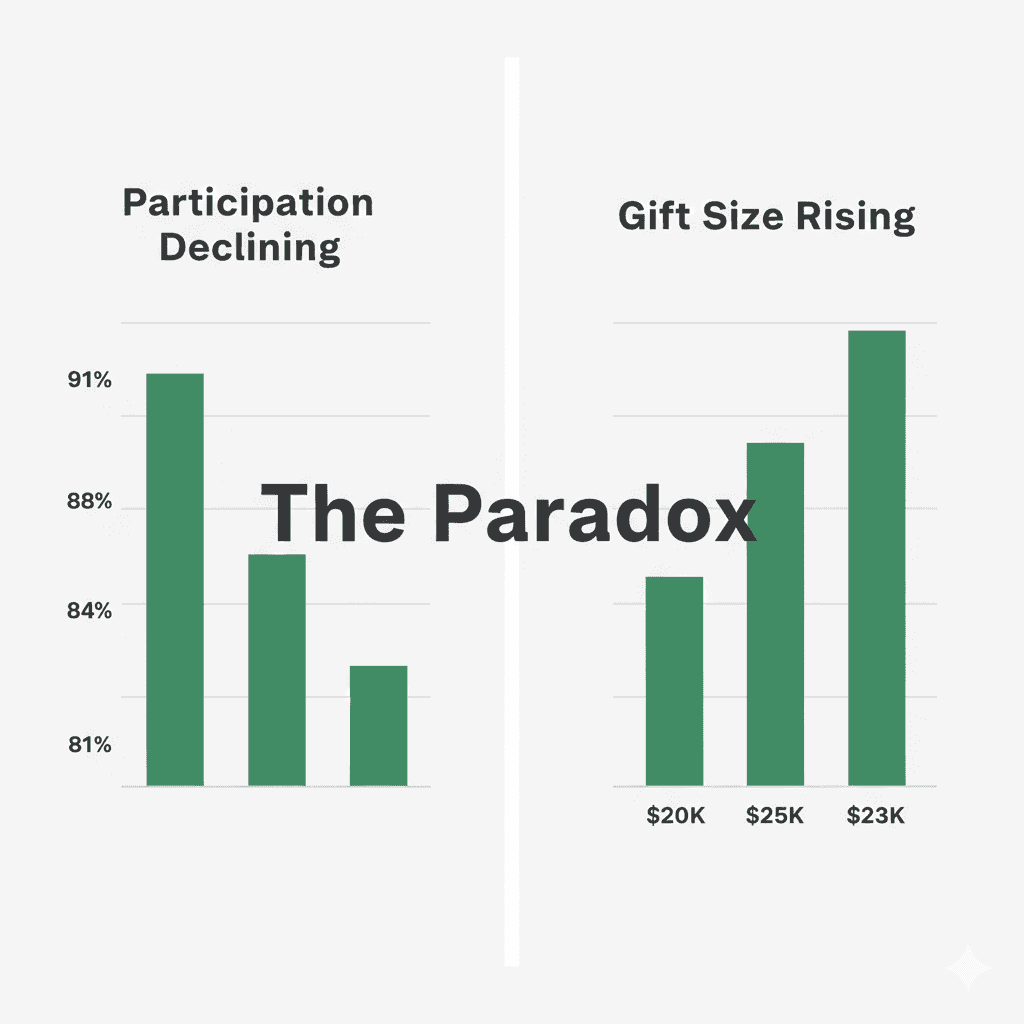
Bank of America's newly released 2025 Study of Philanthropy reveals a troubling trend that should concern every community foundation leader: the coordination crisis in philanthropy isn't stabilizing. It's accelerating.
The Numbers Tell a Stark Story
Affluent household participation in charitable giving has declined from 91% in 2015 to 81% in 2024. That's a 10-percentage-point drop in less than a decade.
But here's what makes this more than just a participation problem: the donors who remain are giving larger amounts with significantly higher expectations.
Average annual gifts from affluent households now exceed $33,000. These aren't casual contributions written at year-end fundraising appeals. These are strategic investments made by donors who increasingly expect to see measurable, demonstrable impact.
The Expectation Gap Is Widening
The study reveals a critical disconnect that community foundations can no longer ignore:
What donors expect:
- Portfolio-level visibility into their philanthropic impact
- Real-time data on what's working and what isn't
- Evidence of coordination that prevents duplication and fills gaps
- Measurable outcomes that justify continued investment
What foundations can currently deliver:
- Fragmented reports compiled from dozens of grantees
- Quarterly or annual summaries with limited visibility
- Anecdotal success stories without ecosystem context
- Grant management systems that track transactions, not transformation
Only 20% of affluent donors currently track whether their giving is having its intended impact. Yet those who do track effectiveness give significantly more and express greater confidence in their philanthropy.
This creates a painful paradox for community foundations: you need to demonstrate impact to retain and attract major donors, but your current infrastructure wasn't built for ecosystem-level coordination.
Why Traditional Systems Fall Short
Most community foundations rely on grant management systems (GMS) designed for a different era. These platforms excel at application intake, compliance tracking, and financial processing. They were built for transactions.
But today's donors aren't asking transactional questions. They're asking strategic questions:
- "Are we actually reducing food insecurity in our region?"
- "Which neighborhoods have no coverage from our grantee network?"
- "How do our funded organizations coordinate with each other?"
- "What's our collective impact across the entire ecosystem?"
Your GMS can tell you who you funded and for how much. It cannot tell you whether those grants are filling gaps or creating overlaps. It cannot show you the coordination patterns (or lack thereof) across your portfolio. It cannot demonstrate collective impact.
The Trust Crisis Beneath the Surface
When donors can track their investment portfolios in real-time with precise metrics but cannot answer whether their $50,000 food security grant actually reduced hunger in their community, something fundamental is broken.
This isn't a technology problem. It's a trust problem.
Affluent donors are reducing their giving participation partly because they lack confidence that their contributions are making a measurable difference. The foundations that can credibly demonstrate ecosystem-level impact will be the ones that reverse this trend.
What Winning Foundations Will Look Like
The foundations that thrive in this new environment won't be distinguished by having the most polished grant applications or the slickest annual reports.
They'll be the ones who can:
- Show complete ecosystem visibility across their entire grantee network, not just individual program reports
- Answer "what's working?" with data, not anecdotes or gut feelings
- Demonstrate coordination that prevents duplication and strategically fills coverage gaps
- Provide real-time insights that match the speed at which donors make other financial decisions
- Prove collective impact that no single grantee could produce alone
The Infrastructure Question
The Bank of America study makes clear that donor expectations are rising while foundation coordination capabilities remain largely static. This gap will only widen.
The question for foundation leaders isn't whether to build better coordination infrastructure. It's how quickly you can implement it before the trust deficit becomes insurmountable.
Your major donors are already making portfolio decisions based on measurable outcomes. Your board is asking harder questions about regional impact. Your program officers are drowning in fragmented data they can't synthesize.
The coordination crisis is here. The foundations that acknowledge it and build the infrastructure to address it will be the ones that secure their relevance for the next decade.
Moving Forward
If you're a community foundation executive director or program officer reading this, ask yourself:
- Can you currently show your board a complete map of where your food security grantees are serving?
- Do you know which neighborhoods have overlapping coverage versus critical gaps?
- Can you demonstrate to major donors how your grants coordinate to create collective impact?
- How much staff time is spent chasing fragmented reports instead of building strategy?
The answers to these questions reveal whether you're prepared for the expectations affluent donors are bringing to their philanthropy in 2025 and beyond.
The good news: this infrastructure gap is solvable. But only if foundation leaders recognize that transaction-focused systems cannot answer transformation-focused questions.
Sources:
Want to see how community foundations are solving the coordination crisis? Learn how FastRoots helps foundations demonstrate ecosystem-level impact.